
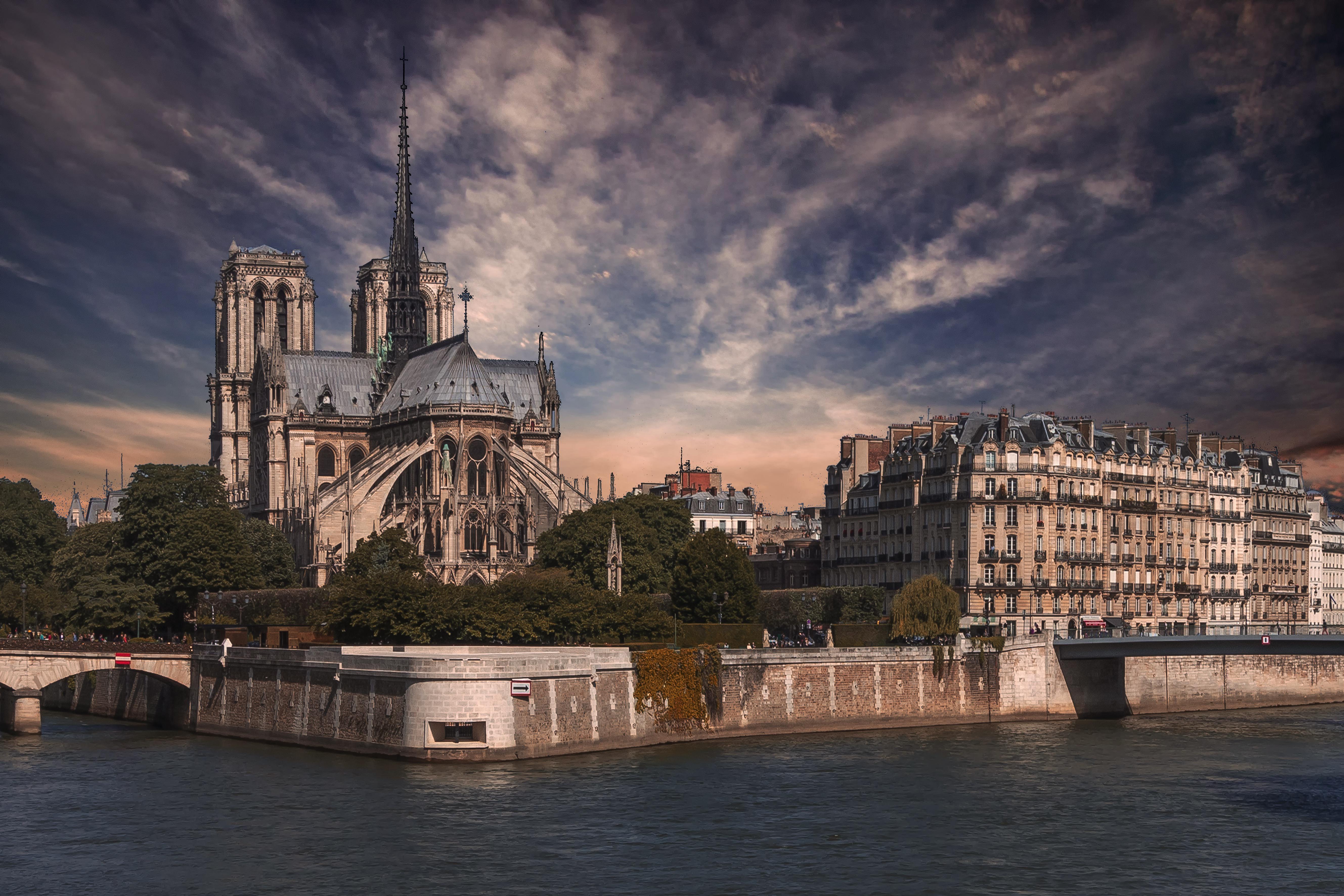
To understand Paris, one must first understand its anchor. The Île de la Cité is not merely an island in the Seine; it is the definitive coordinate of the French story. It is a concentrated dose of two thousand years of urban evolution, packed into 22 hectares of sacred limestone and royal stone.
In 2026, the island holds a renewed gravity. Following the triumphant reopening of Notre-Dame, the parvis has once again become the focal point of the world's architectural attention. But beyond the cathedral's flying buttresses, the island hides secrets of Roman power, medieval revolutionary zeal, and the oldest standing bridge in the city.
This is the island where the Parisii tribe first settled, where the kings of France held court, and where, today, the soul of the city remains most visible.
Two Thousand Years on One Island
The story begins with the *Parisii*, a Celtic tribe who established a fortified fishing village here in the 3rd century BC. When the Romans arrived in 52 BC, they recognised the strategic genius of the island, transforming it into the heart of *Lutetia*.
For centuries, the island was the centre of everything—the religious, administrative, and royal heart of the nation. It was here that Clovis I, the first King of the Franks, established his palace in 508 AD, and it was here that the architectural revolution of the Gothic era would reach its most sublime expression.
Notre-Dame de Paris
Sitting at the eastern tip of the island, the Cathedral of Notre-Dame is the definitive witness to the French narrative. Begun in 1163, it took nearly two centuries to complete, surviving revolutions, wars, and the devastating fire of April 2019.
Following the grand reopening in December 2024, the cathedral has returned to its position as the beating heart of the city. In 2026, visitors can experience the newly-restored interior, where the cleaned limestone walls glow with a warmth not seen in generations. The Rose Windows, the soaring nave, and the intricate theological grammar of the façade remain the pinnacle of Gothic achievement.
Sainte-Chapelle — The Most Beautiful Interior in Paris
If Notre-Dame is about scale and gravity, the **Sainte-Chapelle** is about light and transcendence. Built by Louis IX (Saint Louis) in 1248 to house the Crown of Thorns—purchased for a price higher than the construction of the chapel itself—it is a jewel box of medieval stained glass.
The upper chapel features 1,113 stained glass panels, depicting more than a thousand scenes from the Old and New Testaments. In the morning light, the atmosphere inside is ethereal, a symphony of reds and blues that makes the stone walls seem to dissolve. To visit, pre-booking timed-entry tickets is essential as the space is intimate and highly popular.
The Conciergerie — Royal Palace to Revolutionary Prison
Directly adjacent to the Sainte-Chapelle lies the **Conciergerie**, all that remains of the *Palais de la Cité*, the first royal palace in Paris. Its medieval Great Hall (*Salle des Gens d'Armes*) is the largest non-religious Gothic hall in Europe, a masterpiece of fourteenth-century engineering.
However, the building is most famous for its role during the French Revolution. It was here that Marie Antoinette was imprisoned before her execution. Today, a reconstruction of her cell and a collection of revolutionary artefacts tell a darker, more somber story of the island's history, bridging the gap between royal opulence and republican zeal.
Pont Neuf — Paris's Oldest Bridge
The paradox of the **Pont Neuf** lies in its name—it means "New Bridge," but it is actually the oldest standing bridge in Paris. Constructed between 1578 and 1607, it was the first bridge in the city to be built of stone and without houses built upon it.
It is centered by the equestrian statue of Henri IV, the king who completed its construction. The bridge serves as the gateway to the western tip of the island, the *Square du Vert-Galant*, where you can stand at the very edge of the island and watch the Seine divide around you. The views of the Louvre and the Pont des Arts from this point are unmatched.
The Archaeological Crypt
Beneath the pavement of the Parvis Notre-Dame lies a subterranean world. The **Archaeological Crypt** preserves the remains of Paris from its earliest days. Here, protected from the modern city, you can see Gallo-Roman dock walls, the remains of medieval houses, and the foundations of the 18th-century *Hospice des Enfants-Trouvés*.
It is a profound experience to walk through the literal foundations of the city, understanding the urban density and the layered history that has occupied this small island for two millennia.
Walking the Island — A Suggested Route
1. Pont Neuf: Begin at the western tip, admiring the statue of Henri IV and the views of the Louvre.
2. Quai de l'Horloge: Walk along the river toward the Conciergerie, passing the oldest public clock in Paris.
3. Palace of Justice: Turn into the heart of the island to visit Sainte-Chapelle and the Conciergerie.
4. Flower Market: Stroll through the historic Marché aux Fleurs Reine Elizabeth II on your way eastward.
5. Notre-Dame: Conclude your walk at the parvis, visiting the cathedral and the Archaeological Crypt.
Getting to Île de la Cité
The island is easily accessible from any part of central Paris:
- Metro: Line 4 brings you directly to the center at the **Cité** station—famed for its green elevator cages and Belle Époque ironwork.
- RER: Lines B and C at **Saint-Michel Notre-Dame** place you just a bridge-crossing away from the parvis.
- On Foot: A beautiful approach is walking from Le Marais via the Pont Marie (crossing Île Saint-Louis) or from the Latin Quarter across the Pont au Double.
Discover the Island With an Expert Guide
Two thousand years is a lot to decode alone. Join a state-licensed historian for a private walking journey that connects the Roman ruins, the Gothic majesty, and the royal scandals of Paris's oldest island.
Frequently Asked Questions
What is on Île de la Cité?
The island is home to some of the world's most significant monuments: the Cathedral of Notre-Dame, the Sainte-Chapelle, the Conciergerie (former royal palace and prison), and the Archaeological Crypt, as well as the Palais de Justice and the iconic Pont Neuf.
How long does it take to visit Île de la Cité?
A comprehensive highlights walk of the island takes approximately 2 to 3 hours. If you plan to enter Notre-Dame, Sainte-Chapelle, and the Conciergerie, we recommend allowing a full day (6 to 8 hours).
Is Île de la Cité worth visiting?
Absolutely. It is the historic heart of Paris and the site where the city was born. No visit to the capital is complete without experiencing the Gothic majesty and the royal history concentrated on this small island.
What is the difference between Île de la Cité and Île Saint-Louis?
Île de la Cité is the administrative and religious heart, housing the great monuments. Île Saint-Louis is its quieter, residential neighbor, known for its aristocratic townhouse architecture, boutique shops, and famous Berthillon ice cream.
Can you walk around Île de la Cité?
Yes, the island is entirely walkable and is best experienced on foot. There are several bridges connecting it to both the Right and Left Banks, and you can walk the entire perimeter in under an hour.
Explore the cradle of Paris with Scenic Zephyr Guides.
View More Experiences