
Paris is a city that understands the lens. Between the surgical geometry of Baron Haussmann's boulevards and the soft, reflective surface of the Seine, the capital provides a natural framing that exists nowhere else on earth. To photograph Paris is to participate in a centuries-old dialogue with light and stone.
In 2026, the city has been visually revitalized. From the gleaming white travertine of the restored Notre-Dame to the meticulous maintenance of our royal museums, there are angles available today that have been obscured for generations. But to capture Paris properly—to move beyond the postcard into the profound—requires an understanding of the city's literal and figurative shadows.
In this guide, we reveal the professional coordinates favored by our licensed guides and resident photographers, identifying the precise moments when the city yields its most cinematic secrets.
Why Paris Photographs Better Than Any Other City
The secret to Paris's photogenic quality lies in its calculation. The height of the buildings is perfectly proportioned to the width of the streets, creating a sense of balance that feels intuitive to the eye.
- The Luminous Stone: The Lutetian limestone used throughout the city acts as a natural reflector, bouncing soft, warm light back onto subjects even on overcast days.
- The River as Mirror: The Seine provides a constant, shimmering foreground that doubles the impact of the sunset and the evening illuminations.
- Atmospheric Perspective: The subtle Parisian haze often adds a layer of depth to long-lens shots, creating a dreamy, painterly quality that defines the "Paris Look."
The Iconic Shots — Done Properly
Eiffel Tower from Bir-Hakeim Bridge
The Angle: Stand in the center of the bridge using the iron pillars as leading lines.Timing: Blue Hour. Lens: 35mm to 50mm.The Secret: Wait for a passing Metro Line 6 train on the upper viaduct to add motion and scale to the frame.
The Louvre Pyramid at Night
The Angle: Low perspective from the edge of the surrounding fountains.Timing: 30 minutes after sunset. Lens: 16mm to 24mm (Wide angle).The Secret: If the water is still, you get a perfect reflection. If not, use a long exposure to smooth the water into a silk-like surface.
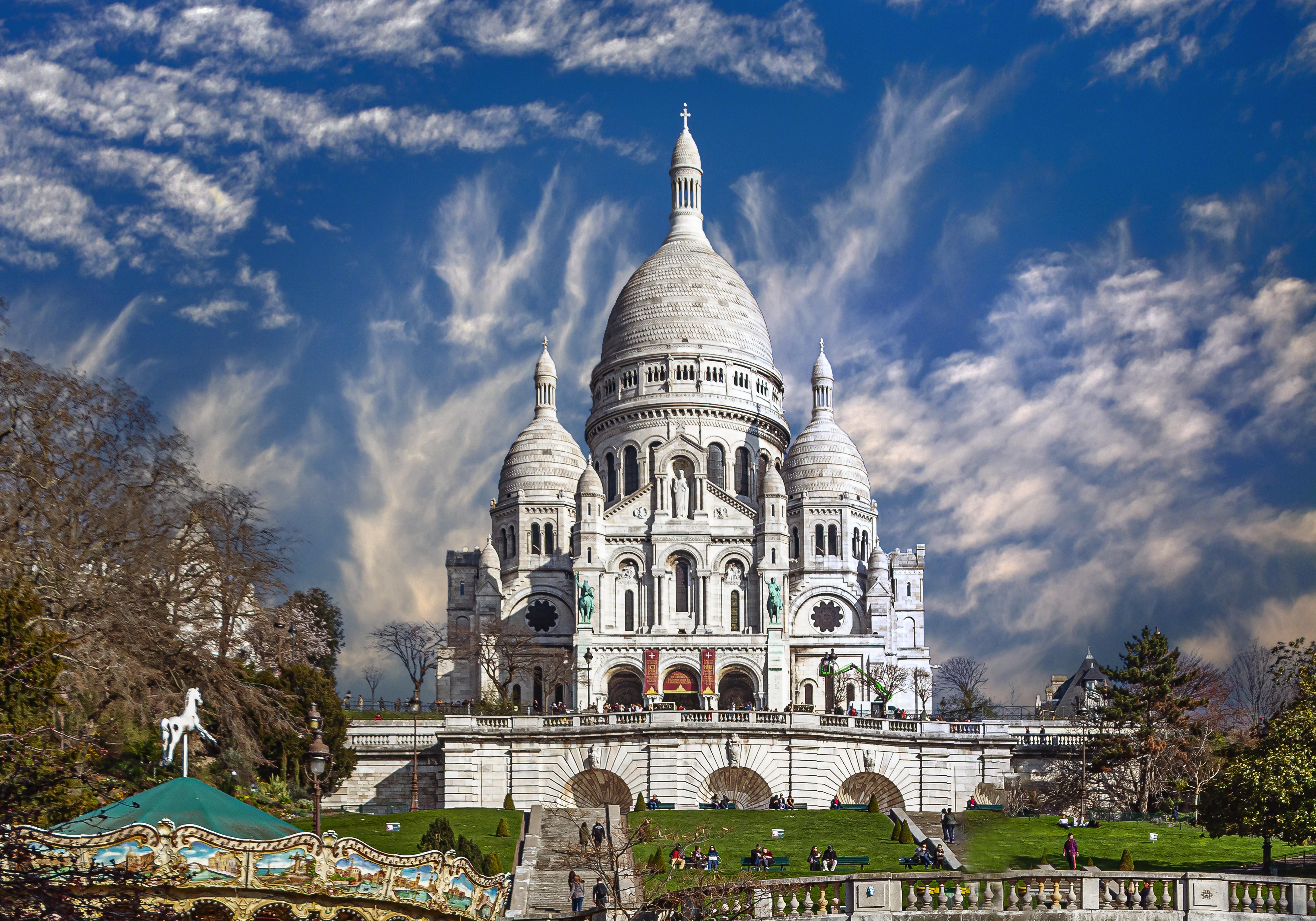
Sacré-Cœur from Rue Lepic
The Angle: Looking up from the base of the hill where the street curves.Timing: Sunrise. Lens: 85mm or 105mm (Telephoto).The Secret:This compresses the colorful storefronts against the basilica's dome, creating a quintessential village-in-the-city feel.
The Hidden Photography Spots
Beyond the landmarks, the soul of Paris is captured in its quiet corners.
- Galerie Vivienne: The most elegant of the 19th-century passages, with mosaic floors and a glass roof that creates a soft, diffused light at all times of day.
- Canal Saint-Martin: The green iron footbridges provide a gritty, industrial romanticism that is the antithesis of the grand Seine boulevards.
- Place Dauphine: A triangular square hidden between the Conciergerie and Pont Neuf. It is perfectly silent at sunrise, with the light filtering through the chestnut trees.
- Rue Crémieux: A cobblestone street of candy-colored houses in the 12th arrondissement—a burst of pastel that feels like another world entirely.
Golden Hour in Paris — Where to Be
Paris is at its most emotional when the sun is on the horizon.
- Morning Sunrise: Pont de la Tournelle. The sun rises directly behind the apse of Notre-Dame, silhouetting the buttresses against a frequently salmon-pink sky.
- Evening Sunset: Pont des Arts. Looking west, the sun sets over the Louvre and the Eiffel Tower, with the river glowing in a sheet of gold.
Photographing Notre-Dame in 2026
Since the reopening in late 2024, the cathedral has a luminosity that hasn't been seen in a century.
The best angle for the whole building is now from the **Quai de la Tournelle** on the Left Bank, which provides the perfect 45-degree perspective of the apse and the new spire. Inside, the light through the North Rose Window at midday creates a dance of saturated color across the newly-cleaned stone of the nave—an exceptional moment for high-dynamic-range photography.
Tips From a Professional Photographer
The most common mistake photographers make in Paris is rushing. The city reveals its best angles to those who wait for the light.
Use people to add scale, but avoid the midday crowds by arriving at your primary location at least 20 minutes before sunrise. If you must shoot during busy times, use a long exposure with a 10-stop ND filter to 'ghost' the moving crowds out of your frame, leaving the static architecture sharp and clear.
Photograph Paris With a Professional Guide
There are angles that maps don't show. Join a state-licensed guide who is also an expert photographer for a private or semi-private journey through the city's most high-performance photography coordinates.
Frequently Asked Questions
What is the best time of day to photograph Paris?
The 'Golden Hour' (the hour after sunrise and the hour before sunset) provides the softest, most cinematic light. However, the 'Blue Hour' (the 20-30 minutes after sunset) is equally critical for capturing the city's transition to its illuminated evening state.
Where is the best view of the Eiffel Tower?
For symmetry, Trocadéro is unmatched. For a cinematic, framed view, the Bir-Hakeim bridge is superior. For a more intimate, local angle, head to the elevated viaduct at Passy or the end of Rue de l'Université.
Can you photograph inside Notre-Dame?
Yes, photography for personal use is permitted inside the cathedral, provided you do not use a flash or tripod. However, photography is strictly prohibited during religious services and ceremonies.
What camera is best for Paris photography?
A full-frame mirrorless camera with high dynamic range is ideal for Paris's mix of shadows and bright stone. A versatile 24-70mm lens covers most architectural needs, while a 70-200mm is excellent for compression shots across the Seine.
What is the best month to photograph Paris?
October and November offer the most atmospheric light, with lower sun angles and frequently dramatic skies. Late March and April are also exceptional for the cherry blossom season along the Seine.
Capture the soul of the City of Light with Scenic Zephyr Guides.
Explore the Collection